
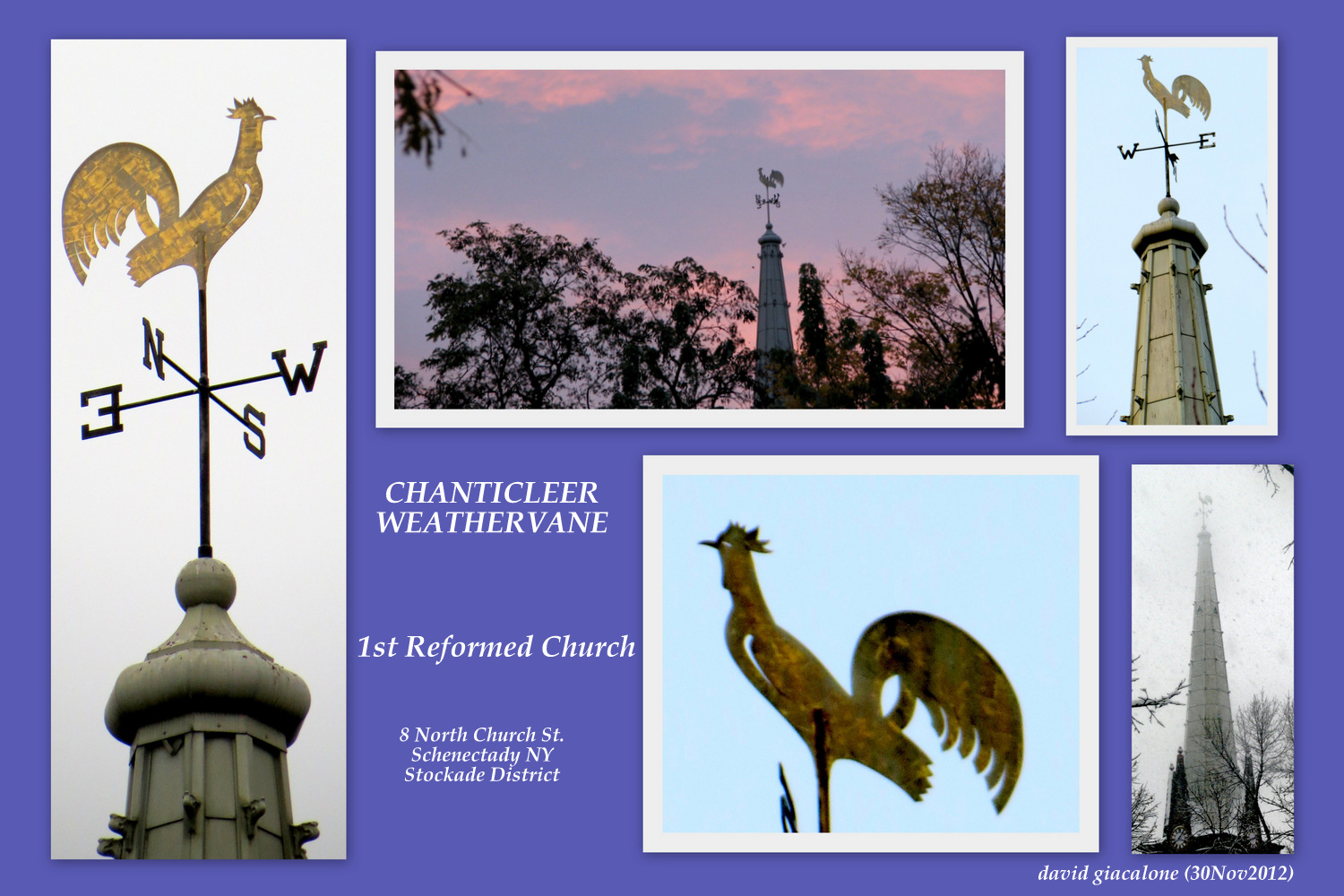
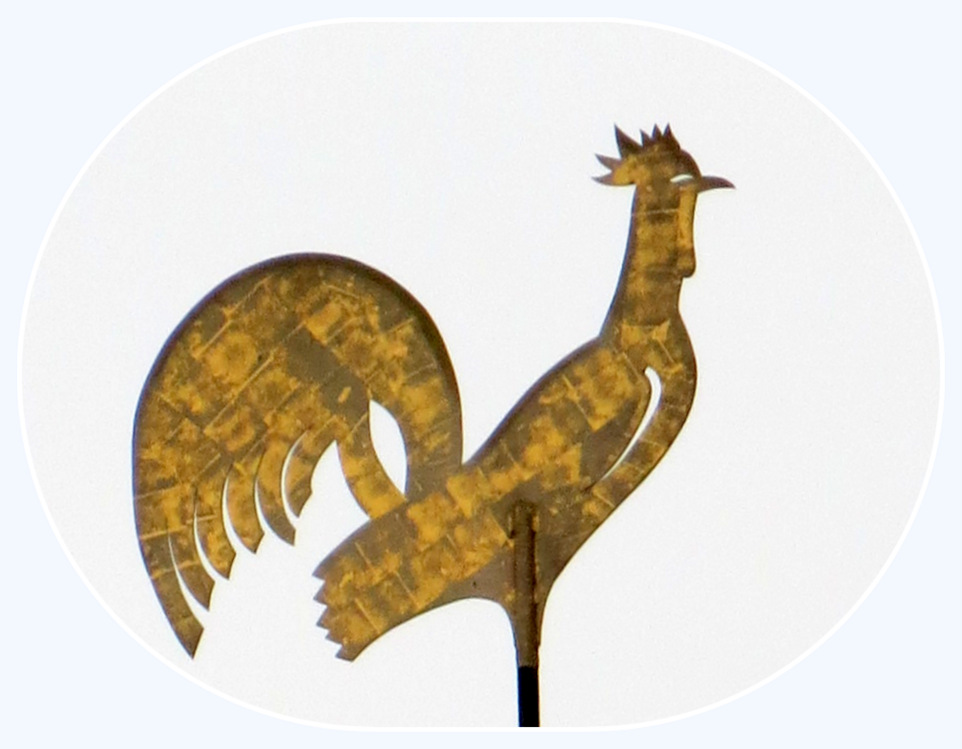
– photo collage of the two Stockade weathercocks, also known as chanticleers, cockerels, and “the cock of St. Nicholas” (click on it for a larger version); St. George’s rooster is on the Left and First Reformed’s on the Right –
 This posting was originally intended to be merely a photo comparison of the Stockade’s two rooster-shaped weathervanes. It was prompted by a chance encounter with neighbor Jean Zegger at last September’s Outdoor Art Show. Jean mentioned her fondness for the graceful, more-whimsical rooster atop St. George’s Episcopal Church on N. Ferry St. Her remarks got me to take a closer look at, and more-close-up shots of, the St. George’s weathercock and its cousin around the corner at First Reformed Church on N. Church Street.
The results of my weathervane photo shoots can be seen above, and in the two collages below, which focus on each weathercock separately (click on them to enlarge):
 . . .
. . . 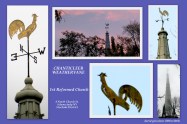
– St. George’s chanticleer (L) and 1st Reformed’s (R) –
 But, things got complicated when I playfully decided to bring a recent article from the Washington Post into the discussion. It told how the current fad for backyard urban chicken coops has resulted in a growing crisis of unwanted roosters, many of which are being deserted on city streets and rural roads, or are being brought to traditional animal shelters that are unsuited for their care. See “Backyard chicken boom produces fowl result: unwanted roosters” (by Annys Shin, Nov. 23, 2012). Of course, the Stockade has neither hens hoping to avoid excess male attention, nor loud, abrasively doodle-doing “chanticleers” (a term taken from an Old French word meaning “sing loud,” and from the name of the rooster in medieval tales of Reynard the Fox).
Therefore, I naturally assumed there would be nothing controversial or undesirable about the Stockade’s silent metallic weathercocks. That was, from a historical perspective at least, a big mistake that cost me many hours of research, and has left me with unanswered questions that I hope our readers will be able to resolve. As always, I also hope that any readers who discover mistakes in this essay will let me know so they can be corrected. As I get new information or better analysis, I will update this posting.
 Unfortunately, St. George’s history webpage does not speak of its weathervanes. As the plaque outside the Church states, a stone tower with spire was added in 1870 to the west front of the Church. I believe the current rooster arrived at that time. But, it may be the same weathercock that had been installed at St. George’s more than a century earlier. That first weathercock is mentioned in a history of First Reformed Church [Two hundredth anniversary of First Reformed Protestant Dutch Church of Schenectady, at 44, by William Elliot Griffis and Jonathan Pearson (1880; full text online)], which tells us:
“In 1735, the Episcopal church was organized, but it was not until 1762 that a small stone edifice was erected, in which the Scotch and English worshiped alternately. Like a good Dutch church, it bears on its weathervane the cock of St. Nicholas.”
The insistence by the 1st Reformed historian that the neighboring St. George’s weathercock was “a cock of St. Nicholas” suitable for “a good Dutch church”, raises some interesting questions, which are discussed below.

- How Old is St. George’s Weathercock? [amended Nov 22, 2013] If the date given above by the 1st Reform historians is correct, 2012 is the 250th anniversary of St. George’s original small stone edifice. There is, however, no certainty about when the first weathercock was erected at St. George’s. In 1880, when Griffis and Pearson wrote the 200-year history of Schenectady’s 1st Reformed Church, they mention the construction of St. George’s stone church edifice in 1762, and add that the St. George’s church building “bears on its weathervane the cock of St. Nicholas.” As written, it sounds as if the authors are speaking in the present tense, and are not dating the weathercock to 1762. St. George’s first stone steeple was not built until 1870, and it surely had a weathercock atop its steeple when Griffis and Pearson wrote their church’s history.
However, we can’t (at least, I can’t) be sure weather St. George’s had a weathercock before the 1870 stone steeple. No written record has been found mentioning whether a weathercock went up when St. George’s built a timber-frame steeple in 1792; nor do we know if there was a weathercock perched on the peaked roof prior to the erection of the wooden steeple in 1792. In his well-researched and well-reasoned article “St. George’s Historic Weathercock”, in the Episcopal Education column of St. George’s September 2013 The Georgian Newsletter, at 9, Daniel Kennison suggests that the whimsical weathercock pictured in this webposting — which was forged from sheet iron and not steel — may have been created prior to the construction of the wooden steeple in 1792. (After inspecting parish expenditure records, which had an item for a celebration “at steeple raising,” Kennison also speculates that the steeple, which has long been presumed to have been erected in 1792, actually went up in 1804. Another possibility is that the 1792 steeple had deteriorated in a way that required it to be rebuilt and re-raised in 1804.)
Jean Zegger’s fondness for the graceful cockerel above St. George’s is understandable. Although it looks great from the ground, I was surprised to find out that Reverend Blanch recently made a Steeple and Window Restoration Appeal (May 29, 2012) to his congregation, in which he noted that “The weather vane needs reseating and re-gilding.”
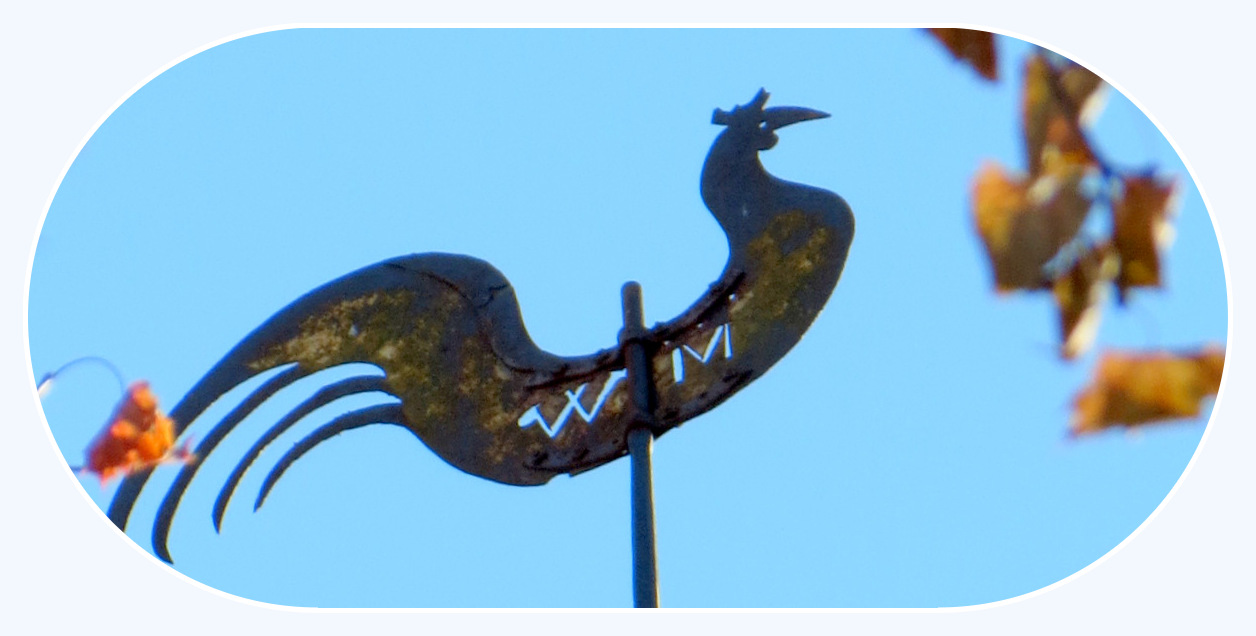
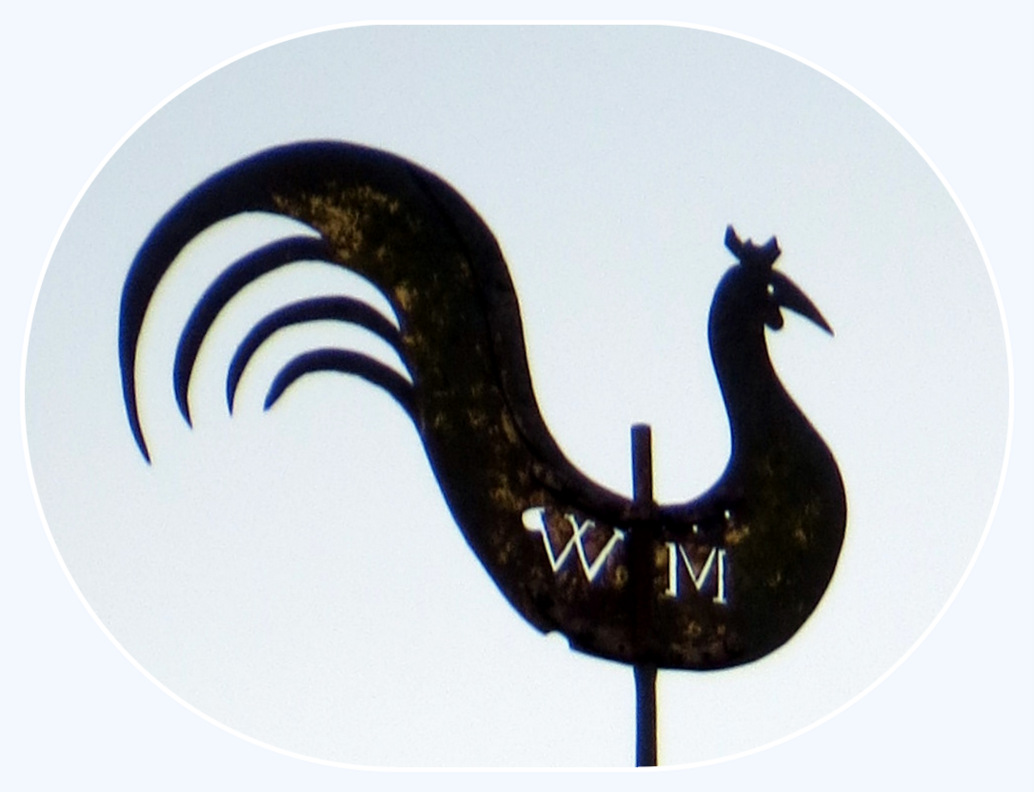
 Until I read that the old bird needs “regilding”, I had assumed it was (and was supposed to be) black in color. But taking a closer look with my recently-acquired 35x optical zoom lens made both the prior gilding and the weathercock’s poor condition evident. [Click on the photo at the head of this paragraph for a close-up.] Please consider helping with Rev. Blanch’s Steeple Appeal to ensure the chanticleer’s proper maintenance and preservation. (And, if you know, please tell me the meaning of the letters “W” and “M” that have been stenciled into the body of the rooster, and its designer.) [After much research and a bit of speculation, Dan Kennison believes the initials MW refer to the original blacksmith, Myndert Wemple. See “St. George’s Historic Weathercock” , supra, in the September 2013 Newsletter, at 8-9. ]
follow-up (Nov. 22, 2013): There’s a new rooster in town. St. George’s had planned to refurbish its deteriorating weathercock, but it was apparently so damaged, that Church leaders decided to replace it with a replica. The old rooster was taken down in July of this year, and its successor erected on Nov. 20, 2013. See our posting on that same day, “St. George’s rooster is back and looking good“, which has photos and a brief discussion.
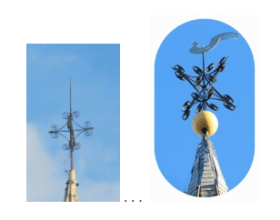
To the far Left above is the rooster-less weathervane mast on July 12, 2013; the second photos shows the new weathercock shortly after it was ensconced on November 20, 2013
 Things got more interesting when I looked into the history and pedigree of the rooster at the top of the First Reformed Church of Schenectady. [Thanks to the church’s historian Laura Linder and the Schenectady County Historical Society for generous help in my research.] I learned both that early Dutch pastors and elders had regularly called such a weathervane “the cock of St. Nicholas” and — not unlike the unwanted roosters described in the Washington Post article — that they were banned from the steeple of the First Reformed Church for more than a century until the current weathercock was installed in 1969. (Don’t fret: the current congregation and consistory at First Reformed apparently harbor no ill will against church-top chanticleers, nor toward nosy neighbors playing muckraker.)
Read More…
 . early January in the Stockade .

 follow-up: On a less-pleasing note, National Grid has again been over-pruning our trees. See “Residents upset after trees trimmed,” by Kathleen Moore, B3, January 18, 2013, online by subscription), and see my posting “more over-trimming by National Grid” for more information, including discussion of Assembly Bill A02300, which attempts to remedy the problem. Let our Assemblymember Phil Steck know how you feel about this topic and the Bill.















 Don’t miss our second posting “




 suns along the Mohawk
Recent Comments