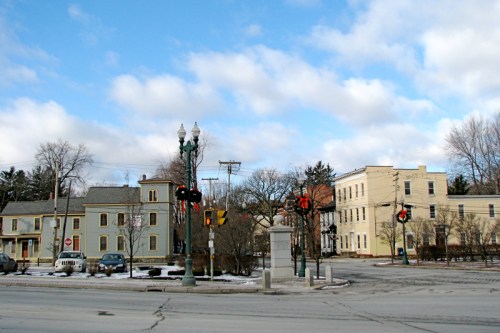
– the noncommercial entryway to the Stockade –
The bagels and soup will probably be great and the ambiance surprisingly tasteful at Jack McDonald’s upcoming Gillette House fast-food restaurant, but there are at least two important issues that the Stockade neighborhood and City planners need to address if we indeed care about the residential nature and quality of life of our neighborhood:
- the façade: we should keep the façade of the Gillette House free from structural changes, such as larger windows and doors, not just for the sake of historical and architectural integrity, but because those changes will surely mean the building will never go back to being used as a residence or professional offices — the variance will become a de facto permanent zoning change
- traffic issues: we must deal with inevitable traffic problems caused when a building that’s been vacant for two decades suddenly brings a lot of customers and employees in motor vehicles to a location near a major intersection and alongside a one-way, one-lane, one-block, one-exit street that empties into a major thoroughfare, a few yards from a busy intersection, without the benefit of a traffic device.
This slideshow suggests some important issues:
This slideshow requires JavaScript.
Saving the façade of the Gillette House: The façades of our buildings are especially prized and protected in the Stockade. Even the most minor changes must be approved by the Historic District Commission. No one altered the structure of the street-side walls of the Stockade Inn when it became a restaurant, nor of the VanDyck when it reopened. Each building tastefully announces its function without damaging the historic face of the structure.
 It seems especially important not to alter the exterior walls of an important historical building such as the Gillette House, especially when it sits at the most prominent entryway to the Stockade. It is the image most visitors (or potential ones) first see at the Gateway to our proudly residential historic district. And, Schenectady County and New York State taxpayer spent over $300,000 to restore that façade precisely because of its prominent location and historic importance as the home and office of one of Schenectady’s most important women.
Those who pooh-pooh worries about the Gillette House façade need to remember that Jack McDonald tends to get his way (even when he wants something that violates our zoning laws) and he told the Zoning Board he wants larger windows for the Gillette House bagel shop. Indeed, Jack rejected my offer not to sue to reverse the unlawful use variance if he would promise not to change the exterior structure of the Gillette House.
 Moreover, despite my urging they get out in front of this issue with strong voices in opposition to façade change, the chair of the Schenectady Heritage Foundation has merely made the very guarded promise to “advocate for appropriate treatment of the exterior of the building,” and the president of the Stockade Association (who voted for the Use Variance as a member of the Schenectady zoning board) has said to just let the Historic District Commission do its job.
Here are a few other things to keep in mind when deciding whether or not to actively work to protect the exterior structure of the Gillette House:
- Changing the Gillette House façade to make it look commercial will turn the use variance into a permanent defacto zoning change. The commercialization of the exterior, along with making the first floor a fastfood restaurant with a commercial kitchen, etc., will certainly mean the building will never revert to a residential use or become professional offices, which are much more residential-friendly in operation and appearance.
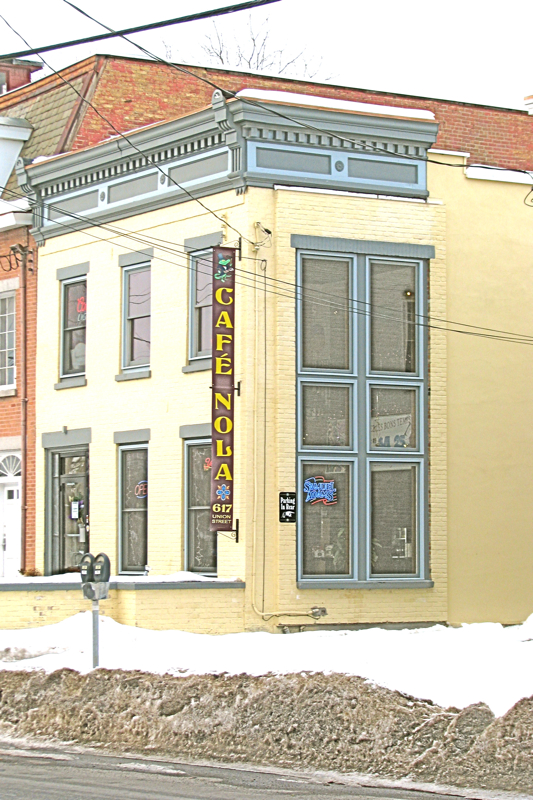
 The Historic District Commission recently allowed Cafe Nola to carve up the side of 617 Union St., part of the Union Street Corridor Historic District, with a giant window display (see above, and click on the photo for a larger version). Followup: Cafe Nola, despite its giant, nonhistoric, commercialized window, closed in December 2016, due to a failure to pay its taxes.
- Despite the mantra of bagel shop supporters that the streetview is already so commercial at the Stockade entryway that nothing is lost by making the Gillette House look commercial, the residential look of the Stockade is still distinct and clearly demarcated from the downtown commercial zone around it [there’s even about 50′ of empty pavement between the rear of the Gillette House and Clinton’s Ditch Bar & Grill].
That’s how it should be at the Gateway to a historic residential district that is the oldest continuously residential neighborhood in the nation, and that is treasured precisely because the Erie Canal (now Erie Boulevard) saved the neighborhood from the commercial development that overran the rest of downtown Schenectady. (For more, including many photographs, see my posting on the Gillette House streetscape.)

- The standard is never “that would look nice, too” (or “that ain’t so bad”, nor “whatever Jack wants”) when the question is whether or not to make significant (or even minor) changes to the exterior of a Stockade building.
- Bakeries, ice cream parlors, and restaurants in historic districts around the nation make use of old homes without changing their outward appearance. And,
- The Gillette House is not “on the periphery of the Stockade.” It is the most prominent structure at the ceremonial gateway to our grand and special Residential Historic District.
Traffic Safety
Read More…























 suns along the Mohawk
Recent Comments